

The General Assembly of the ERCIM AISBL, held on 24 October in Lisbon, unanimously elected Jos Baeten, general director of Centrum Wiskunde & Informatica (CWI) in the Netherlands as its new President for a period of two years as of January 2018. Jos Baeten succeeds Domenico Laforenza from the Institute for Informatics and Telematics (IIT) of the Italian National Research Council (CNR) who served as President of ERCIM since January 2014.
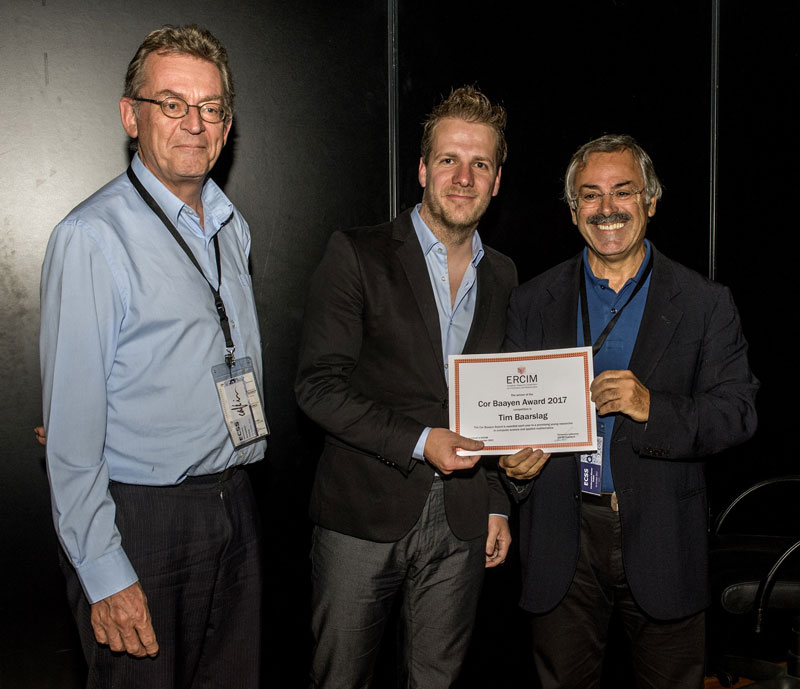
Tim Baarslag from CWI was selected as the winner of the 2017 ERCIM Cor Baayen Award, in a very tough competition with 15 finalists. The award committee recognises Tim’s skills and the results that he has achieved. His enthusiasm for internationally oriented research cooperation, his talent for recognising the potential use of mathematical tools, and his cooperative skills make him a young researcher of outstanding quality.
Read more: Tim Baarslag Winner of the 2017 Cor Baayen Young Researcher Award
ERCIM invites researchers to participate in the workshop "WebVR Authoring: Opportunities and Challenges" in Brussels, 5-7 December 2017. The event is organised by W3C and hosted by DigitYser. The primary goal of the workshop is to bring together WebVR stakeholders to identify unexploited opportunities as well as technical gaps in WebVR authoring.
Read more: W3C Workshop: WebVR Authoring: Opportunities and Challenges
VRE4EIC, an H2020 European research project, coordinated a week of project meetings in Rome 11-15 September 2017 bringing together representatives of major European initiatives involved in environmental multidisciplinary data-driven science.
Read more: VRE4EIC empowers environmental data-driven science

ERCIM is taking a leading role in Europe for driving research activities in VRE. This demonstrated by the contributions featured in a section of of ERCIM News 109. How researchers collaborate is per se a research topic! Many scientific problems are related across different domains: for example, the global climate changes involve knowledge from eco-system, ocean, atmosphere and earth as well as from energy science and human-related activity modelling. Scientists face great challenges in handling collaboration among different disciplines and in modelling and discovering knowledge in massively available data from a wide diversity of domains. Today, data-driven approaches are considered as good alternatives to drive scientific research activities.
Read the whole section at https://ercim-news.ercim.eu/en109/research-and-society-virtual-research-environments