Intelligent Real-Time Closed Circuit TV-based Surveillance, Automated Verification and Access Control
by Shaogang Gong
A project on Intelligent Real-Time Closed Circuit TV (CCTV)-based Surveillance, Automated Verification and Access Controlhas been funded by the UK EPSRC Integrated Machine Vision initiative and carried out at Queen Mary and Westfield College (QMW), London since 1995 and due to complete in 1998. The project has developed an integrated real-time system for automatic detection, zooming and following, acquisition and recognition of moving faces in natural scenes.The work has been motivated by a huge industrial demand in recent years for CCTV camera-based systems that can perform non-intrusive but robust automatic visual tracking, verification and access authorization in natural but known environments. The system been developed is to be commercially exploited by a new venture to be funded by venture capital investments.
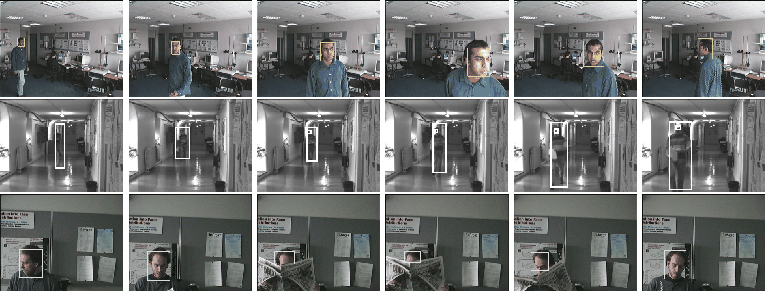
At present, whilst visual surveillance is mainly relied on the detection and discrimination of alarm events based on simple video motion detectors, visual verification and access authorization are largely based on biometric techniques which involve hand, fingerprint, iris and voice recognition. These systems are either unreliable or aesthetically unacceptable and inconvenient, giving slow response and extremely constrained in their operations. This project has been focused on developing automated visual identification of face image sequences automatically detected and tracked by a closed-loop mechanism using conventional on-line CCTV cameras. The system performs face detection and tracking robustly in real-time under a wide range of lighting and scale variations by combining hybrid visual cues including colour, motion and facial appearance models.
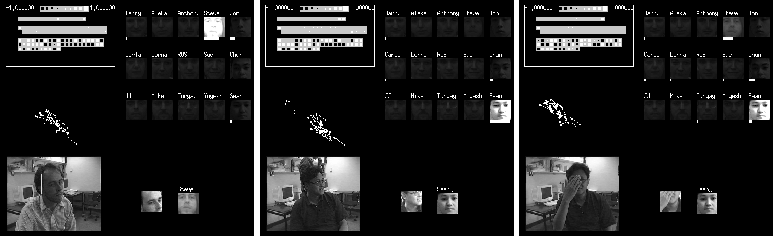
Figure 1: Real-time face detection and tracking under large scale and lighting changes, and of occluded or partially occluded moving subjects.For verification and access control, the project has developed a system that performs real-time face recognition under large changes in scale and pose based on face image sequences instead of static snapshots. One unique characteristic of the system is that the use of sequences as opposed to snapshots not only eases the burden of recognition accuracy placed upon the individual face image frames (fault tolerance), but also makes use of temporal continuity as a powerful additional computational constraint for speed and consistency (temporal prediction).
The research carried out in this project has led to a few commercial developments. These include a real-time intelligent people watching system for surveillance in restricted areas, a one-to-one verification system for ID and access control, and a group identity verification system for criminal intelligence and crime prevention.
Figure 2: Real-time face verification and recognition based on captured sequences of face movements using on-line adaptive learning and temporal prediction.This research has benefited from discussions between the QMW group and Bond Security Services Ltd (UK) and Datacube UK Ltd (UK).
For more information, see web page at: http://www.dcs.qmw.ac.uk/research/vision/index.html
Please contact:
Shaogang Gong - Queen Mary and Westfield College
Tel: +44 171 975 5249
E-mail: sgg@dcs.qmw.ac.uk