Virtual Re-opening of the Leaning Tower
by Claudio Bruno, Mario Fusani and Ovidio Salvetti
Available, inexpensive technology can now transform worlds up-to-yesterday inaccessible into comfortably explorable environments, ready to disclose to our senses their most concealed features. While Jupiter's moons and Mars' landscape mysteries show themselves by a gentle mouse click in our leaving-rooms, other terrestrial, man-forged marvels no one can step on, are waiting for the million-hit visiting contacts. In this domestic universe, still untargeted by any mission, the leaning tower of Pisa is one silvery star which has been chosen for exploration. Why?The tower, one of the most popular and loved monuments in the world, has been closed to visitors for seven years, due to structural instability, while an international committee performs the delicate job of measuring, designing, and enacting gradual strengthening. It will take years to see the work finished.
For the moment, nobody can climb the tower. No-one can enjoy the column-framed view of Piazza dei Miracoli (Square of Miracles) from the windows that lighten the inner spiral stairs, struck by a strange, peculiar, wonderful feeling that the entire outside world, including the horizon, has been tilted. Every day, thousands of tourists can only gaze, nose upwards at the 900 year old marble manufact.
The situation became no longer bearable for the technical and scientific community working in Pisa, whose activity can be traced as back in time as far as the age (and the inclination) of the tower. Some researchers began to get interested in the idea of allowing tourists and scholars to visit the monument again, without actually stepping on it.
The main goal of the Tower of Pisa Experience project is to set up a virtual visit of the tower. And through this demonstrate that current technology can allow many people to experience art and culture, even from a distance or when there are physical impediments. Thus the tower has been taken as a starting point for the exploration of other monuments and their multi-dimensional environ-ments, in a projection which has no defined end.
This is not just virtual reality: Both immersion (that is, the transfer of as much sensory information as our bandwidth and devices can allow between the visitors and the object) and non-immersion (typical multimedia web navigation) modes are peculiar features of the project.
The two basic visiting modes are conceived as follows.
The immersion mode consists of three main units:
- a robot with at least audio and video sensors, placed on top of the tower, or within one of the columned rims
- a remote observation station, with VR apparatus and body markers/sensors
- a telecommunication system to transmit the visitor's movements to the robot and, vice versa, images and sounds from the robot.
The non-immersion mode is implemented as a WWW site which offers on-line, real-time pictures of the tower and its surroundings. A detailed 3D data bank of the Piazza dei Miracoli is also available, so it is possible to navigate through the sights of the square and also consult specialised databases containing information on the art, history and architecture of the monuments.
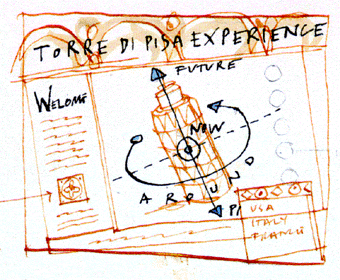
Figure 1: The tower is at the centre of a system of co-ordinate axes, along which various dimensions of knowledge can be explored.
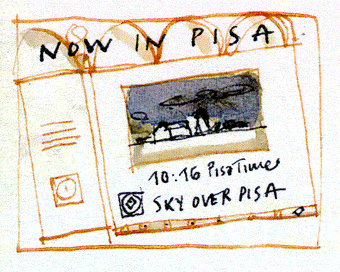
Figure 2: The cross point of the time-streams, represented by real-time, framed images of the Leaning Tower and of the square.
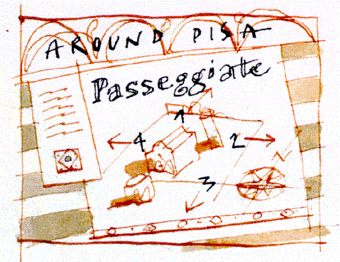
Figure 3: From the square to its urban context. Drawings by Marco Tranquillini.The basic idea is to place the tower at the centre of a system of co-ordinate axes, along which various dimensions of knowledge can be explored. Time and Space are the main guidelines (Fig. 1):
- Up The Future
- Down The Past
- Centre Right now!
- Around the Centre The surrounding area
Centre: This is the cross point of the time-streams, and is represented by real-time, framed images of the Leaning Tower and of the square (Fig. 2)
Down: This is the starting point of the navigation through the 3D models and databases which have been built in the past years
Up: Here it is possible to get information about works and projects related to the future of the tower and the square (eg the work of the International Commission)
Around: From the square to its urban context; a virtual tour exploring the city where all these masterpieces have been created (Fig. 3).
Starting from this basic representation, further links will be provided in order to access and interact with related information sources, such as libraries, other monuments, cultural or local services. In the present approach, the non-immersion mode also aims at describing both the technical and the operational aspects of the immersion mode. We believe that in the near future, following the progress in computer science and telecommunication, both techniques can be integrated for use through Internet, so that the virtual re-opening of the Leaning Tower can be fully accomplished. The first virtual tour of the tower will soon be available under: http://www.iei.pi.cnr.it/projects/tower
Please contact:
Claudio Bruno - Polaris srl
Tel: +39 187 671213
E-mail: C.Bruno@towerpower.itMario Fusani - IEI-CNR
Tel: +39 50 593512
E-mail: fusani@iei.pi.cnr.itOvidio Salvetti - IEI-CNR
Tel: +39 50 593455
E-mail: salvetti@iei.pi.cnr.it