Fabule - A Multi-Purpose Animation System for Simulation and Virtual Reality
by Mathieu Desbrun, Jean-Dominique Gascuel, Marie-Paule Cani-Gascuel and Nicolas Tsingos
Physically-based animation systems are now capable of simulating a vast range of phenomena, by modeling rigid bodies or viscous liquids in dynamic environments. At iMAGIS, a joint project of INRIA, CNRS, Joseph Fourier University and the Institut National Polytechnique of Grenoble, we have developed a flexible animation system called 'Fabule'. The aim is to provide a useful modeling and animation platform for simulation, virtual reality and production of animation films. At the same time, our flexible and adaptive system enables us to easily implement and add new modules, facilitating state-of-the-art research in various fields such as interactive modeling, deformable models, or sound rendering.Animation and simulation research has given rise to a large variety of animated models, providing efficient tools for both simulations and virtual reality. The main difficulty is to offer a unified system that combines standard animation techniques, such as keyframing or rigid body collision handling, and recent developments such as virtual reality techniques. To avoid stilted (or rigid) features and take advantage of re-usability, we have developed Fabule, a flexible programming system along with interfaces and common tools which allows us to build a global and coherent set of various animation techniques. This system was developed focusing on three different topics: modeling with implicit surfaces, fast simulation of deformable materials, and sound rendering.
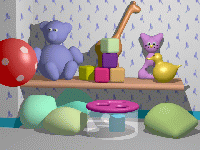
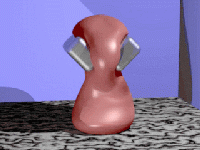
Modeling is the ineluctable first step of any animation. To define the shape of an object to animate, standard techniques make use of parametric patches to model the surface. A new approach has been introduced recently that characterizes an object by giving an equation satisfied by the surface. While having a surface defined implicitly may seem inappropriate, this formulation provides several advantages over parametric surfaces: complex topology objects, with holes and branchings, are handled easily with implicit surfaces; the interior of the object is in addition intrinsicly defined by an equation, which favourably contrasts with conventional boundary representations where computationally expensive tests are needed to determine whether or not a point is in the interior of an object. Fabule offers interactive and intuitive modeling using implicit surfaces (see Figures (a) and (b)).
Deformable models have also been explored extensively at iMAGIS. As implicit formulation of objects allows significant gain in computation time, Fabule provides an efficient and interactive animation platform where objects from elastic to quasi-liquid can be used (see Figures (a) to (c)). The novelty is that our implicit coating can treat precise contact modeling with high quality rendering. Recent developments include space-time adaptive models where resolution is automatically adapted by locally refining or simplifying the sampling according to motion. This principle allows us to concentrate computation where needed, resulting in optimized implementations, which is still rare in animation.
The last avenue explored is the simulation of sound. With the development of virtual reality, soundtrack generation is becoming an important issue in Computer Graphics. Producing convincing soundtracks involves the rendering of sound interactions with the dynamic environment: in particular sound reflection and absorption due to partial occlusions or Doppler effect are fundamental to realism. Fabule enables us to generate realtime soundtracks of simple animations without any post-production, or can simulate sound rendering of a given environment.
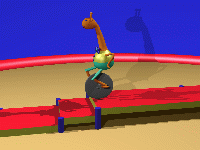
These three aspects, altogether with additional optimized techniques such as articulated structure animation (see Figure (d)), result in a multi-purpose state-of-the-art animation system. A C++ implementation with open hierarchies of modules also makes Fabule a test-bed for research in Computer Animation. Object-oriented support for programming and available tools shorten dramatically the implementation of new research.
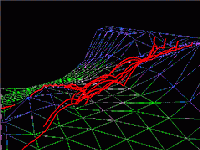
Figures a-e: Snapshots from various animations created with Fabule.
iMAGIS collaborates with the BRGM in Marseille in order to build a geophysical tool for natural risks prediction of rock falls from cliffs. With an approximated set of values characterizing the soil and the vegetation type, several simulations are performed with different initial conditions that help the delimitation of hazard areas (see Figure (e)). An other collaboration is currently active on teleconferencing and virtual reality with the CNET. We also have active contacts with the CSTB of Grenoble for simulation of acoustic rooms and sound rendering, and are involved in the Platform for Animation and Virtual Reality European TMR network. Future activities include further developments of virtual reality techniques.
Further information can be found at: http://www-imagis.imag.fr/FABULE/fabule.html
Please contact:
Jean-Dominique Gascuel or Marie-Paule Cani-Gascuel iMAGIS
Tel: +33 4 76 63 56 85
E-mail: Jean-Dominique.Gascuel@imag.fr, Marie-Paule.Gascuel@imag.fr