Computer Vision Projects in Image and Pattern Analysis Group of SZTAKI
by Dmitry Chetverikov
Image and Pattern Analysis Research Group (IPAN) belongs to the Geometrical Modelling Laboratory of SZTAKI. As a unit of the Research Division at the Institute, the group does research in various areas related to computer vision and its applications. The main activities of IPAN are in texture, shape and motion analysis, including a technologically oriented European project devoted to industrial quality control of ferrite cores and a research project on query-by-image-content in image databases.Texture plays a key role both in human and machine vision. Textures are non-figurative, repetitive patterns that appear on surfaces of materials, in textiles, indoor, outdoor and aerial imagery (forests, fields, towns, etc.), biological and other microscopic images, in documents, eventually in all the categories of images. Basic, perceptually motivated properties of textures are their regularity, anisotropy, and complexity. Recently, a powerful approach to texture analysis, called feature based interaction map (FBIM), has been developed in IPAN. FBIM has been successfully applied in a number of important problems and tasks, including the evaluation of the basic properties as well as texture symmetry; precise determination of texture pattern orientation; rotation-invariant texture classification; adaptive texture filtering selective to local structure and its orientation; invariant detection of textured objects and texture defects; document zone classification; estimation of document page skew for subsequent skew normalization. Many of the FBIM based solutions are already supported by the results of systematic experiments with large test image databases, such as the UW-I document image database compiled at the University of Washington in Seattle.
A related research project will be started soon aimed at query-by-image-content in image databases using keys as texture regularity and anisotropy as well as structure orientation. The concept of FBIM based adaptive structural filtering will be applied to rotation-, scale-, and surface tilt-invariant retrieval of images that contain regions similar in structure to the query pattern. Both texture and shape keys will be used, including characteristic configurations of specific, readily detectable feature points such as corners. Recently, a novel efficient algorithm for detection of corners and other points of high contour curvature has been developed in IPAN.
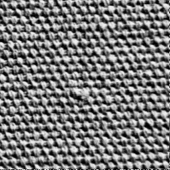
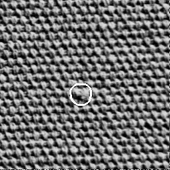
Figure 1a-b: Detecting structural defect in texture.
Left: A textile texture with a structural defect.
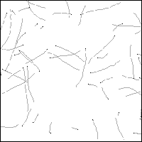
Right: The detected defect overlaid on the texture.Motion analysis is of growing relevance for computer vision since many of real-world vision tasks involve dynamic, time-varying images. Last year, a new research direction was opened in IPAN with the goal of creating methods and algorithms for tracking independently moving, multiple small-size objects represented by their feature points. The points may occur in groups, temporarily disappear, and leave and enter the viewfield, which significantly complicates the tracking problem. This study is based on a previously developed and published algorithm for matching of two subsequent frames of a moving point set assuming smooth trajectories and prior knowledge of the expected direction of displacement for each point. In the current, more realistic formulation, the tracking will be done for long motion sequences without any prior knowledge concerning the directions of displacements. A motion generator has already been developed that will provide a testbed for future tracking experiments. Several alternative tracking algorithms have been implemented for comparative testing, including the pilot version of the new IPAN algorithm.
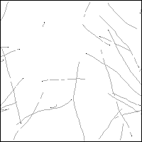
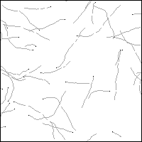
Figure 2a-c: Examples of trajectories synthesized by the motion generator.
In the framework of the EU COPERNICUS research project CRASH (CRAck and SHape defect detection in ferrite cores), an industrial machine vision system has been developed with the goal of detecting and measuring surface and shape defects in ferrite cores. Partners involved in CRASH project are the University of Trento, Italy (project management, signal processing); Technical Software Consultants Ltd., Great Britain (electromagnetic sensor for detection of inner defects); POLFER Magnetic Materials Ltd., Poland (task specification, system validation); IBIB Polish Academy of Sciences and Association of Image Processing Inc., Poland (detection of surface defects). IPAN group created an integrated system for shape measurements of ferrite cores based on the basic projections (views) of the shapes. The system has been successfully tested on a large set of ferrite core images. Using an original subpixel approach to comparison of a measured core shape to the ideal shape, results consistent with the reference manual measurements at the production line have been obtained. Currently, this project is being supported by another grant, INFO-COPERNICUS grant, with the goal of putting CRASH results into industrial practice and facilitating the development of related measurement standards.
Figure 3a-c: Three views of a defective E-shaped core. The shape defect (bent leg) can be observed in the frontal projection.For information on IPAN group, see web page at http://leader.ipan.sztaki.hu/.
The CRASH home page address is http://www.lii.unitn.it/CRASH/.
Please contact:
Dmitry Chetverikov - SZTAKI
Tel: +36 1 2096510
E-mail: csetverikov@sztaki.hu